Showing posts with label language. Show all posts

Tuesday, April 12, 2016

Allogamy


My nightly ritual of allogamous reading keeps a number of books near my bedside at any given time. Some hapless books have been known to hang out there for a year as I read a paragraph or two like a devotional psalter. Some come and go before dawn.

This practice befuddles my husband who believes in doing one thing and doing it well. My daughters are mystified that it takes me longer to read the best books. I often wish I could take them all in faster and once even bought a do-it-yourself Evelyn Woods course. (So many books, so little time!) But chewing the cud is part of the fun for me. I've camped out on one page of Mary Karr's book for the last two nights (page 11-12) and I've been reading Osnos' book (a 2014 Christmas gift from my husband) out loud for a year with one of my ESL students. It is excellent, by the way, and as my student's allotted hours are almost over, I hope to finish the book soon!

Death by Living, on loan from Julie, will be returned to her when I visit this weekend. Wilson's book is a rollicking ride, a fast read that simultaneously slows me down to appreciate my own life while spurring me on to do more without fear. This memoir's mantra is, throw caution to the wind and dare to live with one hundred percent attention to the world surrounding you.

Anam Cara, because, like Allison, I didn't finish it the first time around.

Marilynne Robinson, because, as an exasperatingly difficult read, I need to - like cod liver oil.

Daily Rituals has been eye-opening and hilarious. It's a compilation of great artists and their work habits. Need I say more?

Robert Cording, one of my favorite contemporary poets, just released this book. Allison knew I'd love it for Christmas. I read it like Psalms. So good.

Cross-pollination: because it would be fruitless to do it any other way.


Thursday, June 29, 2006

The Shadowland of Shibboleth


Xibolai. The seminary student was using it a lot and I felt pleased I could translate my favorite Chinese word. It means "Israelite" and sounded remarkably like my favorite Hebrew word—Shibboleth. You may have heard the word shibboleth. In modern usage, it refers to an entrenched belief or custom that defines a culture. Depending on how you pronounced it in Hebrew three thousand years ago (it meant growth or flow), well, it could have you killed.

The book of Judges tells the complex story of inter-tribal conflict between the outlaw Jepthah of Gilead and the men of Ephraim (all of them Israelites) that led to land grabbing and warfare. When the men of Ephraim tried to cross back into their land, the men of Gilead would force them to say the word Shibboleth. If they said Sibboleth (an ear of corn), there was no mercy.

Unfortunately, Xibolai (希伯来语) was one of only ten words I could translate during the sermon. So, for lack of anything else to do, I began computing. This July 4th weekend marks the sixth anniversary since I returned from a three year teaching stint in China. If I had continued my language studies and learned just one Chinese character per day, I would be literate in Chinese. If I continued learning at that pace for the next three years…. Look at it this way: a scholar knows at least 5,000 of the 10,000+ unique characters in the language and based on my computations, I’d be downright scholarly.

Sunday afternoon, I dusted off my language books and methodically penned the calligraphic strokes of my first word: (tone 3), which means woman, girl, daughter. I was so impressed with my ability that I decided to move on to zi (tone 3), which means infant; child; son. My calligraphy looked good to me and I moved on. The next word was hao (tone 3), which means good; right; excellent. Interesting, at least to my eye anyway, was that the composition of this character combined the strokes for woman and son to form the character for “good.” Hmmm. Turning the page, I rediscovered the word for peace, which is: an (tone 1). This character placed the strokes for “woman” under the strokes for “roof.”

Brad walked in about this time and I showed him my resurrected skills. He was my informal language coach in China and he used to shower me with kisses whenever I did well. I’m not sure why we quit our lessons, but I do remember being thoroughly frustrated by the tonality of the language. After a few serious faux pas, such as encouraging people to “eat night soil” instead of “eat more food,” I gave up. Kisses or no kisses, it was easier to communicate in English.

I mentioned my observation of the characters and how they reflected the shibboleths of the culture. If a son with a wife means “good,” and a wife under a roof means “peace,” then what would be two girls and a wife under a roof? My challenge was meant as a rhetorical question, a prompt for cheese that might elicit a witty answer like “love” or “happiness.” He looked at me for a brief moment and in his eyes shone the telling signs that I had made another classic faux pas. My husband exhaled (had he been holding his breath?) “It’s the word for adultery,” he said. “Don’t go trying to make up words in Chinese. It can’t be done. But you’ve done a very good job writing your characters.” And he kissed me.

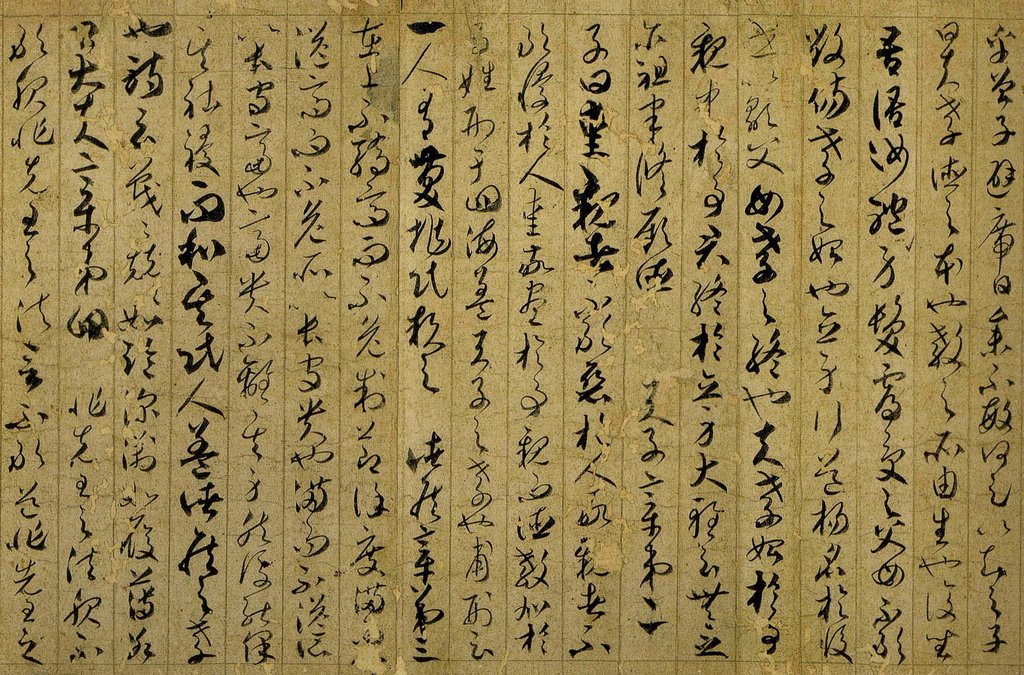
(calligraphy work by He Zhizhang, Tang Dynasty poet)

Friday, May 19, 2006

When The Trees Bow Down Their Heads

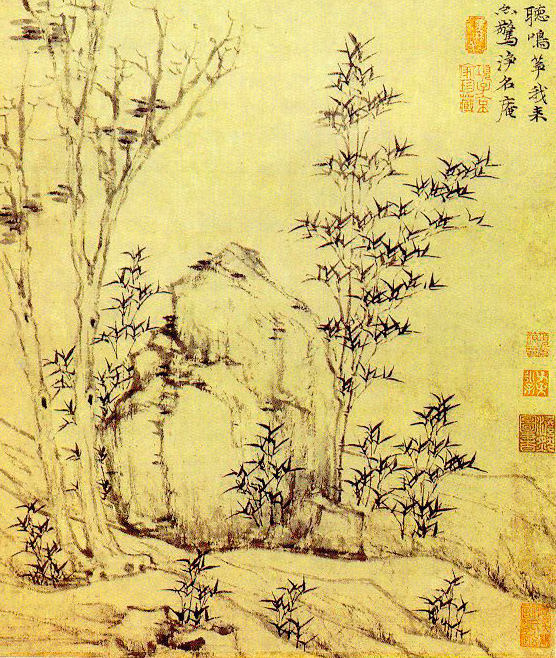
Ni Zan:Trees in Autumn Wind

Hannah is learning to read. Last week, she saw the word MOM on a commercial and read it out loud so I'll just say that was her first word (though she's been sounding things out for several months now.) Hannah is four and she's been able to identify the alphabet since she was two. She taught herself to write the letters and learned the sounds when she was three. Now she's putting it all together. She came to me the other day with paper in hand and asked me to write down a poem for her which began with this provocative line:

I love how the wind whispers.

Could she have started earlier? Yes. But at this stage, I'm more fond of watching things develop organically. I hope she'll approach all learning the same way - with enthusiasm and desire. She'll start Kindergarten in the Fall and face sixteen-plus years of schooling. Hopefully I can teach her good study habits and how to discipline her time so there's space to suck in whatever captures her fancy.

I've struggled some with the issue of home-schooling. I happen to me a strong advocate of it; it's just not for me. If we still lived in our old neighborhood in Houston, I would make the necessary sacrifices. But we don't. We live in a suburb (now a monetary sacrifice) that has the second highest rating in Texas and I am comfortable sending her to school. And glad. I am neither patient nor disciplined enough to tackle such a responsiblity. But I have given it some thought.

I recently read an article sent to me by my friend, Lisa Ohlen Harris. The article is a theological book review by Susan Wise Bauer, a well respected reviewer for "Books and Culture" magazine. She also happens to be writing a history of the world for W. W. Norton. Well. I'm impressed. Susan was home-schooled and co-wrote a book with her mother called The Well Trained Mind. She's a walking billboard for advocates of the movement. So are my friends, Scott and Julie Brister, who live in Austin. They have four daughters and have made home-schooling a priority in their family. They are almost mission-minded about it and it's bearing fruit. Their oldest was studying Latin and comparative philosophy at fifteen - and loving it. Each child plays an instrument, sings, dances, makes their own clothes, ... well, you get the picture.

As I send Hannah off to Kindergarten, I know I'll wonder. Should I have done it differently? Am I being too selfish? Is the world too harsh; are the teachers amoral; are the kids insensitive? Will she be scarred? Held back? Steered in the wrong direction? Maybe yes to all of the above. But if I don't have the passion to teach like Susan's mom or Juie Brister, I imagine worse things for my daughters. For now, we delight in reading stories "together" and picking out words that she can sound out. For now, I can write.